Evolution: Survive or Go Extinct
Generation 1. You’re a blob. No speed, no armor, no venom. Nothing.
Three mutations are offered: grow legs, develop a shell, or sprout tiny wings.
You pick legs. +2 Speed.
The earth rumbles. A volcano erupts. You needed Heat Resist or Wings. You have neither.
EXTINCT. Generation 1.
Welcome to Evolution — where every mutation is a gamble and every environment is a death sentence you didn’t prepare for.
The Game
Evolution is a survival strategy game played one generation at a time. You control a creature’s evolutionary path by choosing mutations. Then nature throws a challenge at you. If your traits are enough to survive, you advance to the next generation. If not, extinction.
The question is never “will you survive?” It’s “how long?”
How It Works
The Mutation Phase
Each generation, you’re offered three mutation options. Each one modifies your creature’s traits — sometimes boosting one, sometimes trading one for another.
Example choices:
| Option A | Option B | Option C |
|---|---|---|
| +2 Speed, -1 Size | +1 Armor, +1 Cold Resist | +3 Venom |
Option A is a trade-off — you gain speed but lose size. Option C is a pure buff — straight venom boost, no downside, but it’s hyper-specialized. Option B is balanced — two small gains across different categories.
Which do you pick?
If you knew what challenge was coming, the answer would be obvious. But you don’t. You’re building a creature blind, hoping your evolutionary bets pay off.
The Ten Traits
Your creature has ten traits, each ranging from level 0 (nothing) to level 5 (mastery):
| Trait | Emoji | What it handles |
|---|---|---|
| Speed | 🏃 | Predators, catching prey, escape |
| Armor | 🛡️ | Attacks, harsh weather, impacts |
| Camouflage | 🌿 | Predators, hunters, hiding |
| Venom | ☠️ | Predators, competition, defense |
| Intelligence | 🧠 | Traps, puzzles, tool use, planning |
| Heat Resist | 🔥 | Volcanoes, deserts, fire |
| Cold Resist | ❄️ | Ice ages, blizzards, frozen terrain |
| Aquatic | 🌊 | Floods, ocean, rivers |
| Wings | 🪽 | Migration, escape, reaching food, flight |
| Size | 📏 | Intimidation, strength (but hurts hiding) |
Each trait is color-coded with a progression that feels earned:
- Level 1: Gray — barely there
- Level 2: Green — developing
- Level 3: Blue — capable
- Level 4: Purple — powerful
- Level 5: Gold — mastery
Watching a trait bar turn gold after careful generations of investment is deeply satisfying.
The Challenge Phase
After you choose a mutation, nature strikes. A random environmental challenge appears:
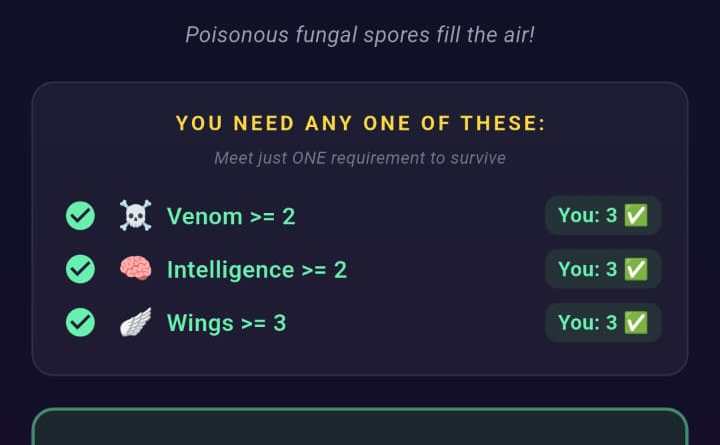
🌋 Volcanic Eruption! The ground splits open. Lava flows toward your habitat. Survive with: Heat Resist ≥ 3 OR Wings ≥ 2 OR Speed ≥ 4
The game checks your traits against the challenge’s requirements. If ANY condition is met, you survive. If none are met — extinction.
The drama is in the reveal. The game shows “Checking traits…” with a brief pause. Your eyes scan your trait bars. Do you have Heat Resist 3? No, it’s at 1. Wings? Level 2 — wait, the requirement is ≥ 2. That might work.
SURVIVED.
The relief is real.
42 Challenges
The game has 42 unique environmental challenges, divided into tiers:
Early Challenges (Generation 1-5): Require single traits at modest levels. “Predator Attack” needs Speed 2 or Camouflage 2. Most creatures survive these if they’ve invested in anything useful.
Mid Challenges (Generation 6-12): Require higher single traits or combos. “Tsunami” needs Aquatic 3 or Wings 3. “Rival Species War” needs Venom 3 or Size 4 or Intelligence 3. These punish creatures that spread too thin.
Late Challenges (Generation 13+): Brutal. “Meteor Strike” needs Armor 5 or Wings 4. “Supervolcano” needs Heat Resist 4 AND Speed 3. These demand either mastery in one area or competence in several.
The challenge pool is weighted by generation — early challenges don’t disappear, but harder ones become more likely. You might cruise to generation 10, then face three brutal challenges in a row.
The Strategy Dilemma
Evolution’s core tension is the specialist vs. generalist problem.
The Specialist dumps every mutation into one or two traits. By generation 5, they have Speed 5 and can outrun anything. But if they face an Ice Age (requires Cold Resist or Armor), they’re dead. One bad matchup and it’s over.
The Generalist spreads mutations across many traits. By generation 5, they have six traits at level 1-2. They can survive early challenges that need any trait at 2. But they can’t meet the level 4-5 requirements that appear later.
The optimal strategy is somewhere in between — and it shifts based on what mutations you’re offered and what challenges you face. There is no fixed “best build.”
This is what makes Evolution replayable. Every run is different because:
- Mutation options are random
- Challenge selection is random
- Your decisions compound — an early choice for Venom means later mutations that boost Venom are more valuable
The Creature Card
Your creature is represented as a living card that evolves visually. It shows:
- Generation number — your survival count
- Emoji representation — composed from your top traits (a creature with Wings and Venom shows 🪽☠️)
- Title — your creature earns titles as it ages: “Newborn” → “Survivor” → “Adapted” → “Thriving” → “Apex Predator” → “Eternal”
- Trait grid — all 10 traits with colored bars showing levels
Watching your creature accumulate traits across generations creates genuine attachment. By generation 15, you’re not playing a game — you’re protecting something you built.
Why It’s Addictive
The “one more generation” loop. After surviving a challenge, you immediately want to see what mutation options come next. After choosing a mutation, you immediately want to know what challenge comes next. The two-phase structure creates constant forward momentum.
The extinction sting. Losing at generation 14 after carefully building a creature for 5 minutes feels bad in the exact way that makes you want to try again. You can see where you went wrong — “I should have taken Cold Resist on generation 8 instead of more Venom.”
The diversity of strategies. Every run suggests a different path. Get offered three Speed mutations early? Maybe this run is a Speed build. Get Wings and Aquatic? Go for a flying ocean creature. The randomness of mutations shapes your strategy organically.
Score Breakdown
| Metric | Scoring |
|---|---|
| Generation | 1 point per generation survived |
| Diversity | Bonus for having many traits above 0 |
| Total | Generation score + diversity bonus |
The best generation record is saved locally. Beating your record becomes the long-term goal.
Tips for Survival
Don’t ignore rare traits. Heat Resist and Cold Resist seem niche — until an Ice Age or Volcanic Eruption appears and nothing else saves you. Having at least level 2 in environmental traits provides critical insurance.
Trade-offs are usually worth it. A mutation offering “+3 Speed, -1 Size” is almost always better than “+1 Speed” with no downside. The bigger gain outweighs the small loss.
Watch the generation counter. After generation 8, challenges require level 3-4 traits. After generation 13, they require level 4-5. If you’re at generation 10 and your highest trait is 3, you’re living on borrowed time.
Wings are the best general trait. They satisfy more challenges than any other single trait — escape, migration, flood survival, reaching food. If in doubt, take Wings.
Built With
- Flutter — smooth phase transitions and animations
- 42 hand-crafted challenges — each with thematic descriptions and multiple survival paths
- ChangeNotifier — reactive state management
- shared_preferences — best generation record persistence
- Custom trait bar widget — with 5-tier color progression
- Dramatic challenge reveals — suspenseful “checking traits…” animation
The Question
How many generations can your species survive?
Pick your mutations. Face the environment. Adapt or die.